Storytime at Celia: Imaginary Journeys and Early Literacy Skills
Is it weird if I say that my favorite thing about being a parent was reading to my kids?
What a joy it was to spend an hour on the couch with a toddler, a kindergartener, and a stack of picture books. I liked it even better when they grew a little older and we would squish together on the bed with The Phantom Tollbooth or Howl’s Moving Castle or Charlotte’s Web.
I loved sharing the pleasure of a story and also of language, falling together under the spell words cast when loosed into a room.

Being part of a circle with many listeners while someone is reading a book brings a similar but distinct kind of delight. Storytimes in libraries, community centers, and bookstores offer a communal experience much the way theater does, taking a whole group of humans on an imaginary journey together.
A couple of months ago, a friend with a two-year-old said to me, “There’s no storytime in Swarthmore for working parents to take their kids.”
I was surprised, but she was right. The Swarthmore Public Library has amazing storytimes–I’ve often stopped to listen to Children’s Librarian Scott Schumacher reading, singing, and blowing bubbles in the amphitheater in good weather, but these programs are seldom held on the weekends.
Later, when the store’s less dusty, we’ll take the books out of the boxes and put them on the shelves. By the time this process is over, every single book in the store will have passed through our hands.
Every now and then, the work is interrupted by someone exclaiming, “Oh, I love this book!” I love seeing our staff excited about the books we ordered. I love discovering which pristine object of paper and glue and ink contains a story that matters enough to one of us to spark an exclamation of delight.
For today, this experience is just ours. But soon, on October 4, we’ll open our doors and invite you in to share it.

Immediately after this conversation, I began to make plans for Celia Bookshop to fill the gap.
I reached out to some people I knew would bring energy, creativity, and humor to our store on Saturday mornings. To my delight, everyone I asked said yes. Our line up includes a Swarthmore borough council member, a cosmologist, a retired elementary school teacher who once told me about a field trip to Africa she took her students on, and a bilingual Swarthmore College student bookseller who is interested in adding some Spanish-language stories to the mix.
Each of these readers will lead storytime once a month, bringing different voices, enthusiasms, and approaches. We’ll have some special guests too, including local authors with new books. Also my daughter Anna, a children’s librarian in Alexandria, Virginia, whose storytimes have a devoted following (I’ve visited and seen the joy and the learning).

When I asked Anna why storytime is valuable beyond the pleasure it brings, she told me that when adults “sing, talk, read, write, and play together with children, the kids develop ‘early literacy skills’—the building blocks a person has to have before they can start the formal process of learning to read and write independently.”
I particularly loved hearing about the value of singing together. Singing breaks words down into their component sounds, supporting the early literacy skill of “phonemic awareness”—the ability to hear and identify the smallest units of sound, which helps children learn how words are put together. (If you want to nerd out on this stuff, there’s more information here, including a great tree poster about early literacy practices.)
Whether you’re in it for the enrichment or just for the delight, we hope you’ll join us at Celia Bookshop on Saturday mornings at 10 starting October 11. It’s free and no registration is required. Let’s fall under the spell of words and go on imaginary journeys together.
Recommendations

Wolf Bells
By Leni Zumas
Here at the brink of a forest on a cliff above a river in a valley between haunches of limestone was a steep brown ship of a house. The roots of the trees circling the ship had met corpses, been shredded by hooves, and seen a freak summer when every live thing froze. On the concrete foundation that sat on the dirt that sat on a crust of basalt were twenty rooms, nine bathrooms, and one porch. Metal and plastic and clay, glass and acrylic and wood, two kinds of cedar, three kinds of fir, a hundred deep winters stood through.
A house with twenty rooms, nine bathrooms, and a porch! I love books about big houses, from Rebecca by Daphne Du Maurier to Evelyn Waugh’s Brideshead Revisited to Shirley Jackon’s The Haunting of Hill House.
Zumas’s story, which takes place in a decaying ship captain’s house, is not exactly a ghost story. Rather–as suggested by the eclectic mix of materials listed above (metal, plastic, clay, glass, cedar)–the house here is the site of an experiment: an intergenerational community where paying elderly residents are cared for by young people who live rent free.
I love the music of Zumas’s writing. Listen to how, in that opening passage, she lets phrases chase after one another, and the exuberant way she lets the numbers climb (two, three, a hundred!). It’s no surprise that two of the main characters played together in a semi-famous band called the Bolts (“a symbol of both the domestic–fabric–and the sublime–lightning”) before they had a falling out, grew old, then reconnected.
Another cool thing is that each chapter is named for the room in which it takes place: Dining Room, Soundproofed Room, Infirmary, Fish Bowl.
I can’t resist mentioning another amazing book by Zumas from a few years ago, in case you missed it. Red Clocks weaves together the stories of four women struggling with conception and abortion, imagining a near-future world in which Roe v. Wade had been overturned. That was in 2018.
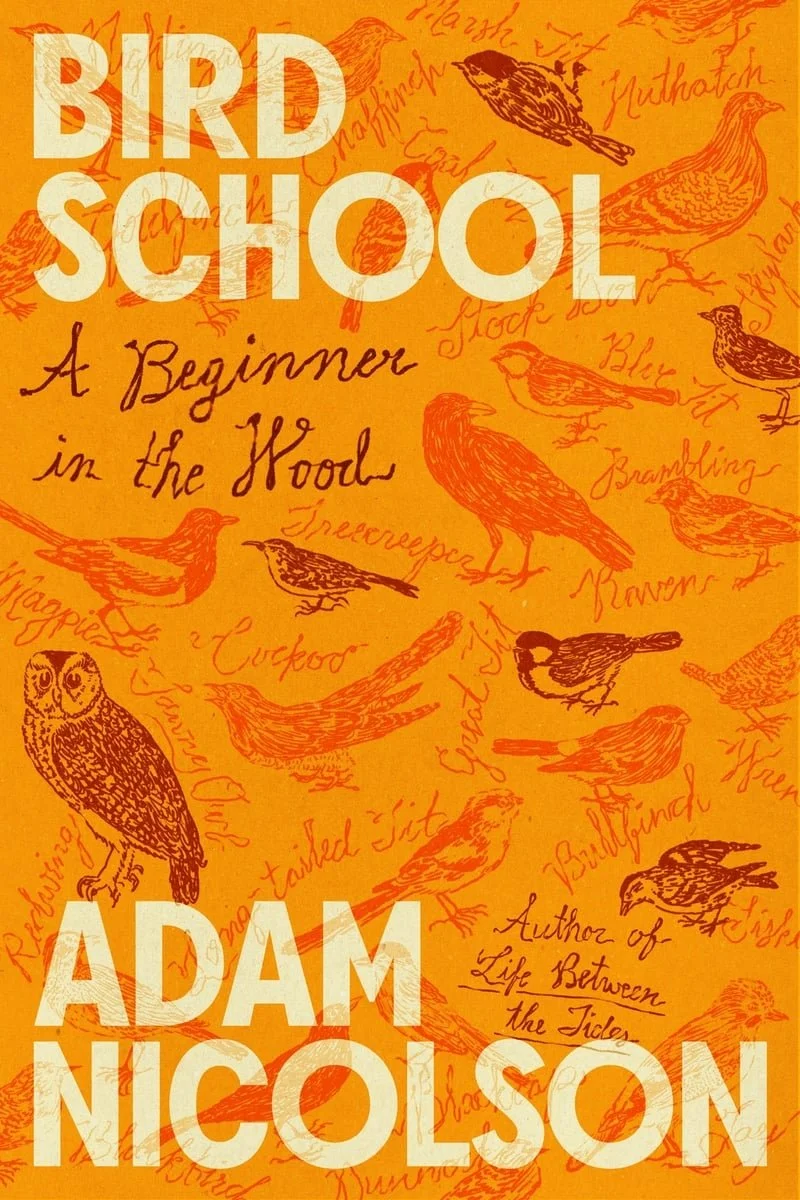
Bird School: A Beginner in the Wood
By Adam Nicolson
The first time I met a bird close-up, it was dead. A raven. Even seeing it on the side of the mountain road in Crete was a shock: a large, dark splayed body the size of a small dog. I stopped the car and got out, not quite certain if I would find a wounded animal, enraged at its fate and frenzied in pain. But it was properly dead. Whatever it had once been had left.
Every time I come back to the opening sentence of this book about a man who decides to learn more about birds by building a half-open shed on his small former dairy farm in Sussex, it makes me laugh.
No disrespect to the poor dead raven–ravens are amazing. What’s funny is, first, Nicolson obvious strategizing to engage the reader from the first sentence, and, second, the paradox of meeting a creature when it’s dead. Is that meeting it, really? What is Nicolson trying to say?
One starts to get the sense that this writer is not just interested in birds, but also in other, maybe stranger questions. My favorite part of the book is his exploration of the idea that remaking a place to be more bird-friendly could also be part of a broader reculturing (his word) of the world. However, the individual chapters on wrens, robins, ravens, and other avians, which mix direct observation with natural history and literary references, are also delightful.
I got interested enough in Nicolson to Google him and was excited to learn that he is the son of Nigel Nicolson, whose beautiful and personal biography of Virginia Woolf is sadly out of print. Which means of course that Adam Nicolson is also the grandson of famed diplomat Harold Nicolson and the larger-than-life Vita Sackville-West, writer, celebrated gardener (Sissinghurst!), and lover to Virginia Woolf, who memorialized Sackville-West in the extraordinary time- and gender-bending novel Orlando.
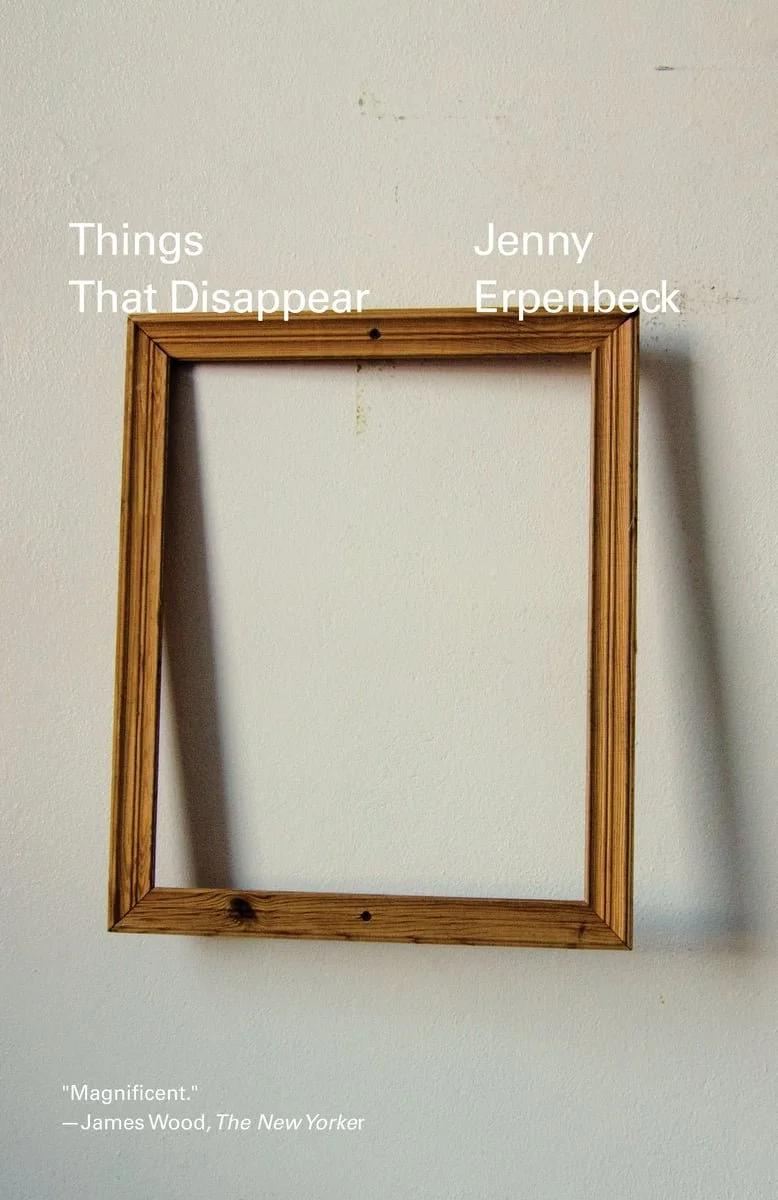
Things That Disappear
By Jenny Erpenbeck
When the Palace of the Republic opened, I was in the third grade. My teacher was named Fräulein Kies, and Fräulein Kies held an envelope bearing an image of the new palace up above her head and explained to us what a first day cover was. At the time, it didn’t occur to me that the phrase “first day cover” had the same number of syllables, and almost exactly the same number of vowels, as “nine day wonder.” Fräulein Kies said that each of us was going to get one of these first day covers, and that we should take good care of it, because one day we’d be proud that we were there when the new palace opened.
After Fräulein Kies presented those first day covers to us, we went on a class field trip to the newly opened palace of the people.
That this slim, extraordinary book by Jenny Erpenbeck is translated from German perhaps explains some of its mysterious qualities. I had to look up “first day cover,” “nine day wonder,” and “Palace of the Republic,” (though maybe you didn’t). After the first short section, Things That Disappear becomes more concrete, full of apartment building courtyards, municipal dumps, old coal stoves, and the author’s son drawing realistic hearts on a piece of paper.
Yet the book remains mysterious. The short memories and reflections that make it up are simultaneously concrete and enigmatic as they explore all the things we are always losing as time slips forward: small things like scarfs and pieces of smelly cheese; profoundly meaningful ones like gravesites; intangible ones like views and the ability to darn socks; monumental ones like the Palace of the Republic.
Erpenbeck uses repetition in this opening and throughout the book hypnotically, as though the words are a spell propelling us into a different way of experiencing the world. It’s as though she’s insisting that all the lost things that fill and haunt this book still exist–will continue existing–through the magic of the writer’s naming them.
To receive this newsletter in your inbox, please sign up here.